Beyond traditional rankings, discover why we need better measures of higher education systems to evaluate the real distribution of academic excellence through the new HESIndex.
As countries compete in an increasingly knowledge-driven economy, understanding the performance of national Higher Education Systems (HES) has become more important than ever.
While university rankings provide valuable insights into individual institutions, they tell us little about how a higher education system performs.
This creates a systemic challenge for policymakers, researchers, and institutional leaders seeking rigorous evidence to guide public investment, structural reforms, and strategic planning.
HES Index, a metric for higher education systems
To mitigate this analytical gap, the study “Beyond university rankings: Classifying national higher education systems through SIR performance concentration” introduces a new indicator: the HES Index.
This system-level metric is designed to capture the actual distribution of institutional performance within national environments.
The HES Index provides a foundation for exploring how system-level characteristics relate to performance, helping policymakers and researchers identify patterns that may otherwise remain hidden. Using correlational analysis, clustering techniques, and multidimensional scaling (MDS), we demonstrate how the index can support meaningful comparative analysis across national systems.
As higher education becomes increasingly central to innovation and economic growth, developing robust system-level measures is essential. The HES Index is an important step in that direction.
The contribution of the SCImago Institutions Rankings (SIR) to higher education systems
Studying takes a different approach from the traditional one. Using data from the SCImago Institutions Rankings (SIR) covering more than 5,000 universities across 145 countries, the SIR provides the scale needed to analyze higher education systems as systems, and not just as collections of elite institutions.
Universities are evaluated across three main dimensions:
- Research Performance (50%)
- Innovation Outputs (30%)
- Societal Impact (20%)
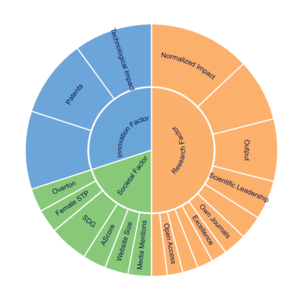
Together, these dimensions are built from 20 open-access indicators that capture not only scientific excellence but also innovation, knowledge transfer, sustainability, visibility, and societal engagement.
Performance of the overall ecosystem
Understanding a country’s higher education system requires looking beyond its flagship universities. A robust national assessment should reflect the performance of the broader ecosystem, not just a handful of institutions at the top of international rankings.
Higher education systems can achieve success through very different pathways—but understanding how performance is distributed may be just as important as measuring excellence itself.
Check the full research here